
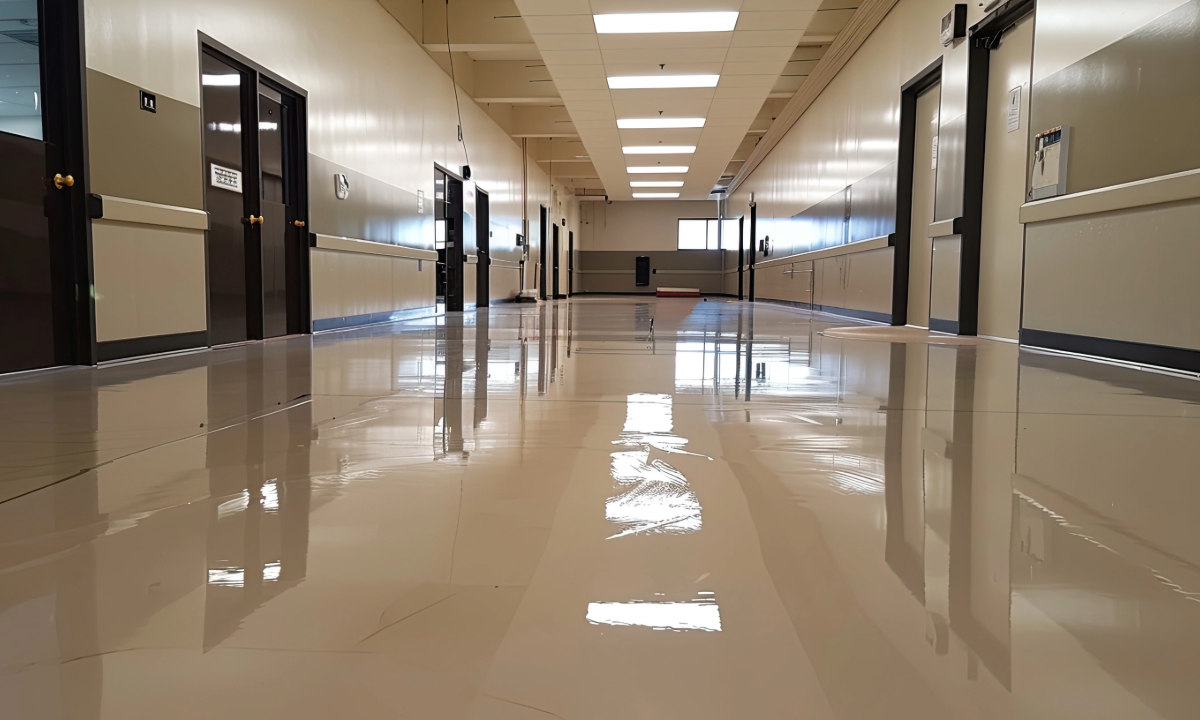
In most commercial buildings, a worn or dull floor is a reputation problem. In a Downtown Rochester hospital or large medical facility, it is something more serious. A compromised floor surface in a healthcare environment creates infection control gaps, slip-and-fall hazards for patients who are already physically vulnerable, and compliance documentation concerns for facilities subject to Joint Commission review or CMS inspection.
The stakes are genuinely higher in a hospital. Not dramatically, not as a sales argument — just factually, in ways that anyone who manages a large healthcare facility in Rochester already understands from experience.
What Makes Hospital Floor Waxing Categorically Different
The floor maintenance requirements in a Downtown Rochester hospital or large medical center differ from any other commercial building in several specific ways. Understanding those differences is the starting point for building a floor care program that actually meets the environment’s needs.
Infection control surface integrity. Hospital-grade disinfectants used in healthcare environments are more aggressive than any commercial office cleaner. Quaternary ammonium compounds, accelerated hydrogen peroxide, and sodium hypochlorite solutions used at healthcare concentrations chemically degrade floor finish faster than standard commercial cleaning chemistry. Without frequent professional maintenance, hospital floors lose their sealed, non-porous surface condition — and a porous floor surface cannot be effectively disinfected, regardless of how much disinfectant is applied to it.
Patient mobility safety. Patients in hospital corridors, outpatient waiting areas, and medical building lobbies are often using mobility aids — walkers, canes, crutches, wheelchairs. Many are post-procedure, medicated, or physically weakened. A slick wax surface applied incorrectly, or a bare, worn surface with uneven traction, creates a fall risk that the facility carries both clinically and legally. Proper commercial floor finish, applied in appropriate coats and maintained on schedule, provides a controlled, consistent traction surface that reduces that risk measurably.
Equipment and wheeled cart traffic. Medical-grade equipment carts, crash carts, IV poles, hospital beds, and transport wheelchairs move across hospital floors constantly. The concentrated pressure and abrasion from medical equipment wheels destroys floor finish faster than foot traffic alone. High-traffic corridor sections in a Downtown Rochester hospital can exhaust floor finish in as little as six to eight weeks under peak operational conditions.
The Specific Floor Zones in a Hospital That Need the Most Attention
Not every square foot of a hospital or large medical building wears at the same rate. Dimensional Services approaches large healthcare facilities with a zone-specific methodology that allocates service frequency based on actual wear and risk rather than applying uniform treatment to every area.
- Main lobby and public entrance corridors: Highest visitor traffic, most visible to the public, first impression for every patient and family member who enters the building
- Patient care unit corridors: Constant wheeled equipment traffic, frequent disinfectant mopping, and 24-hour operational demand — the fastest-wearing floor zones in any hospital
- Emergency department floor: Combination of high volume, rapid-response equipment movement, and frequent chemical cleaning creates extreme wear conditions
- Outpatient clinic waiting areas: High foot traffic during business hours with a patient population that includes mobility-impaired individuals — appearance and traction are both priorities
- Administrative and office corridors: Lower clinical risk but still patient and visitor-facing — maintained less frequently but not neglected
Floor Finish Products That Meet Healthcare Environment Standards
Using the wrong floor finish in a hospital is not a cosmetic problem. A finish product not formulated for healthcare cleaning chemistry will degrade rapidly when exposed to disinfectants used at proper healthcare concentrations. Dimensional Services uses commercial floor finish products appropriate for healthcare environments — products with higher chemical resistance, greater film hardness, and compatibility with the specific disinfectants your housekeeping staff uses.
We also use HEPA-filtered equipment in patient care areas to prevent any particulate redistribution during the stripping or application process — the same standard your housekeeping staff uses for routine care in those spaces.
Scheduling Hospital Floor Service Without Disrupting Patient Care
There is no convenient time to shut down a hospital corridor. Dimensional Services works with environmental services directors, facilities managers, and housekeeping supervisors to identify the lowest-risk windows for each zone — overnight, early morning before scheduled procedures, or during planned unit downtimes.
For large facilities like those in Downtown Rochester’s medical district, we can section work across multiple nights, completing one zone per session so no operational area is affected for more than a few hours at a time. We communicate directly with your facilities team throughout the process and leave complete documentation of what was serviced, when, and with what products — documentation that supports your compliance records.
We are fully licensed, insured, and bonded, and our team has experience working within the access and safety protocols of large medical facilities. Read about the documented costs — financial, safety, and compliance — of deferring floor maintenance in medical buildings.
Frequently Asked Questions
How often should hospital corridors in Downtown Rochester be professionally stripped and waxed?
High-traffic patient care corridors typically need a full strip-and-wax cycle every two to three months under active hospital conditions. Outpatient clinic waiting areas and administrative zones may only need service two to three times per year. Dimensional Services creates a zone-specific schedule matched to actual wear rates in your facility.
Is floor stripping safe in areas near patient rooms or active clinical spaces?
Yes, with proper protocols. We use low-VOC stripping solutions appropriate for occupied healthcare environments, ventilate work areas, and confine all work to the specific zone being serviced. Patient rooms and active clinical areas are never accessed during the service process.
What floor types are most common in Downtown Rochester medical buildings?
Sheet vinyl and VCT are the most common hard floor surfaces in healthcare corridors and patient areas. Both are appropriate for professional stripping and waxing when done with products and processes suited to healthcare environments. Sealed concrete and linoleum are also present in some older Rochester medical buildings and receive appropriate treatment based on surface type.
Does Dimensional Services provide service documentation for compliance purposes?
Yes. We provide written documentation of all services performed — date, zone, products used, and process followed — that can be maintained in your environmental services records and referenced during facility inspections or accreditation reviews.
Can you work with our existing housekeeping team rather than replacing their protocols?
Absolutely. Dimensional Services functions as a specialized contractor for the deep floor restoration work that your housekeeping team cannot accomplish with standard equipment. We complement your team’s daily and weekly protocols rather than competing with them, and we can advise your staff on compatible daily cleaning products that preserve floor finish longer between our service cycles.
Protect Your Downtown Rochester Medical Facility’s Floors and Standards
Healthcare floor maintenance is not a task that should be assigned to whoever has a mop and a free hour. Dimensional Services brings professional equipment, healthcare-appropriate products, and over 20 years of commercial floor care experience to every job in the Greater Rochester medical community.
Call 585-206-3131 or request a free facility assessment online. We will evaluate your building zone by zone and build a floor maintenance program that meets healthcare standards.